
It is with deep concern we have heard that the UK government has decided to withdraw its financial support for the Global Polio Eradication Initiative (GPEI).
The GPEI depends on financial support that enables the World Health Organization (WHO) and UNICEF to maintain their actions on the ground around the world. Even prior to the UK’s announced budget reduction, the GPEI was forced to reduce its 2026 budget by almost 30% compared to 2025 as a result of reduced global health funding from major donors. The decision by the United Kingdom to stop providing funds to the GPEI after 2026 puts at risk the great efforts that have been made over the last 40 years to improve the health and wellbeing of children across the world.
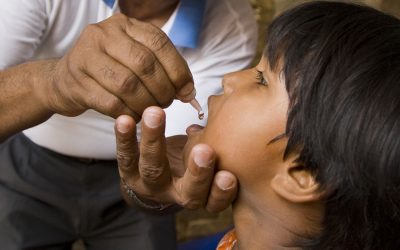
We are at a critical stage in the campaign to eradicate polio, infection numbers in Pakistan and Afghanistan are very low, but this is a result of great efforts on the ground in these last two endemic countries. Pakistan has 400,000 people working in vaccination teams, in Afghanistan teams are working street by street in cities, towns and villages to ensure that every child is reached.
Vaccination teams operate in very dangerous regions along the border between the two countries where they are constantly at risk of attacks and violence. Conflict between the two countries has put them at further risk but still the effort to vaccinate goes on, a recent drive in Pakistan inoculated 45 million children.
These challenges extend beyond the two endemic countries of Pakistan and Afghanistan. Today, outbreaks of variant polio persist in the world’s most fragile settings. Humanitarian crises, conflicts, and disasters complicate efforts to vaccinate every child against polio, while logistical challenges and resource constraints make it hard to respond quickly to every outbreak. As immunisation rates remain low globally, the risk of international spread is high, even to places long polio-free.
Last year traces of the polio virus were found across Europe. In January this year, traces were found in wastewater in London. Failure to eliminate the polio virus in Pakistan and Afghanistan would open the door to new outbreaks in countries where the virus was eliminated. We cannot afford to be complacent.
Loss of financial support for the eradication campaign could have dire consequences. We face the last mile of this journey and it would be tragic if all the efforts of the last four decades to eliminate polio were to fail at this final step. Failure now would have direct implications for every country, every community, every family around the world.
Rotary International pioneered the campaign to eradicate polio. Our members have given huge amounts of financial, volunteering and advocacy support to this endeavour, and we remain fully committed to the task of eradicating polio as our organisation’s number one humanitarian goal.
Alongside our partners and in collaboration with national governments including the UK, we have helped immunise more than 3 billion children against polio in 122 countries, prevented over 20 million cases of paralysis and reduced the number of polio cases by 99.9%.
We intend to fulfil the promise made 40 years ago, to safeguard the health of children by eradicating polio. We sincerely hope that the UK government will consider future support for this goal which is anticipated to save US$33 billion in health-related costs by the year 2100 compared to the ongoing costs of outbreak control and treatment.
Now, more than ever we need every Rotarian and supporter to do everything possible to back our campaign. We need to redouble our efforts to ensure that we succeed, that we achieve our goal, that this, our most important humanitarian cause is realised, we must End Polio Now.
James Carmichael, Rotary GB&I End Polio Now Coordinator
Amanda Watkin, Rotary GB&I Chief Executive Officer
Heather Stuart, Rotary GB&I Chair of the Board
You can read the Global Polio Eradication Initiative’s statement on their website.
Donate online to our End Polio Now campaign.