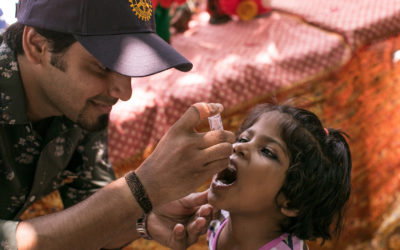
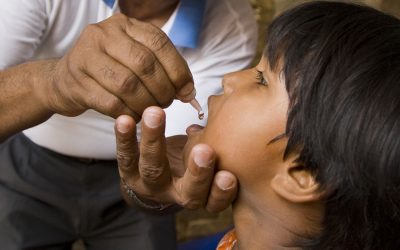
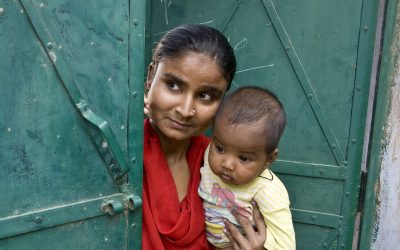
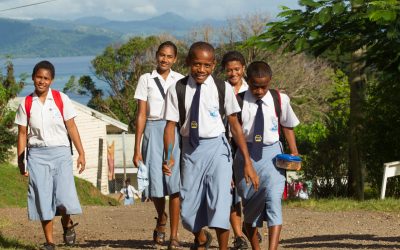

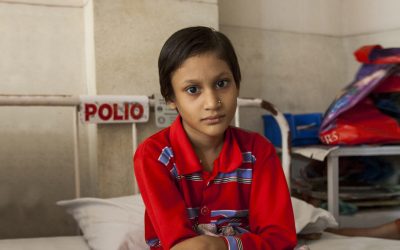
Next week marks the beginning of the largest and fastest globally coordinated rollout of a vaccine into routine immunisation programmes in history. Between 17th April and 1st May, 155 countries and territories around the world will stop using the trivalent oral polio vaccine (tOPV), which protects against all three strains of wild poliovirus, and replace it with bivalent OPV (bOPV), which protects against the remaining two wild polio strains, types 1 and 3. This effort will provide better protection for children against polio, particularly those most vulnerable to infection.
This transition, referred to as the global vaccine “switch”, is possible because type 2 wild polio has been eradicated. The switch has been recommended by the Strategic Advisory Group of Experts on Immunisation and endorsed by the World Health Assembly as a critical component of the polio endgame strategy.
“We’re closer than ever to ending polio worldwide, which is why we are able to move forward with the largest and fastest globally synchronised vaccine switch ever,” said Michel Zaffran, Director of Polio Eradication at the World Health Organization. “It is a massive undertaking, but it is testimony to how much progress is being made toward achieving a lasting polio-free world and to the commitment of all countries to make this dream a reality.”
The oral polio vaccine (OPV) has been used to stop polio in most of the world. On very rare occasions in under-immunised populations, the live weakened virus contained in OPV can mutate and cause circulating vaccine-derived polioviruses (cVDPV). More than 90% of cVDPV cases in the last 10 years have been caused by the type 2 vaccine strain. Withdrawing tOPV and replacing it in routine immunisation programmes with bOPV will eliminate the risks associated with the type 2 vaccine strain and, just as importantly, boost protection against the two remaining wild strains of the virus.
The switch must be globally synchronised because if some countries continue to use tOPV it could increase the risk of the spread of type 2 poliovirus to those no longer using tOPV. The switch is the first major step toward the eventual removal of all OPV after wild polio transmission has been stopped.
“This is an extremely important milestone in achieving a polio free world,” said Reza Hossaini, Chief of Polio at UNICEF. “Hundreds of thousands of vaccinators and health workers have been trained for the switch to happen quickly and effectively, so that children everywhere can be protected from this devastating disease.“
To ensure that the switch takes place as planned, thousands of independent monitors will confirm the absence of tOPV at public and private service facilities and cold chain stores.
“The switch is a massive undertaking and is only possible due to the tremendous collaboration of country governments, Global Polio Eradication Initiative partners, and the independent monitors. It is another example of the programme moving in the right direction toward global eradication,” said Jay Wenger, Director of the Polio Programme at the Bill & Melinda Gates Foundation.
In countries at higher-risk of a polio outbreak, a dose of inactivated polio vaccine (IPV) has been added to routine immunisation schedules, in addition to bOPV, to further boost immunity. To protect against the very small risk of an outbreak of cVDPV type 2 after the switch, a global stockpile of monovalent OPV (mOPV) type 2 is ready to be dispatched if an outbreak occurs.
“The stockpile of mOPV type 2 is like an insurance policy in case there is an outbreak,” said Stephen Cochi, Senior Adviser to the Director of the Centres for Disease Control and Prevention’s Global Immunisation Division. “A lot of time has been spent evaluating the possible risks and minimizing them.”
The switch is a significant milestone in the effort to achieve a polio-free world. In 2015, there were fewer cases reported in fewer countries than ever before. This year, the focus is on reaching every child with the polio vaccine and stopping the virus in its final strongholds. In order for that to happen, donors must continue to invest in the eradication effort.
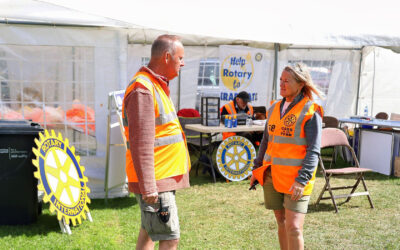
“When Rotary started the campaign to end polio, more than 350,000 children were paralysed every year by this deadly virus,” said Michael K. McGovern, Chair of Rotary’s International PolioPlus Committee. “This switch is an important step, but we must maintain our support until every last child is safe from this disease.”
Click here to read a further comment from Rotary member Judith Diment, Chair of the Polio Eradication Advocacy Task Force and Member of International PolioPlus Committee.
Published: Friday 15th April 2016